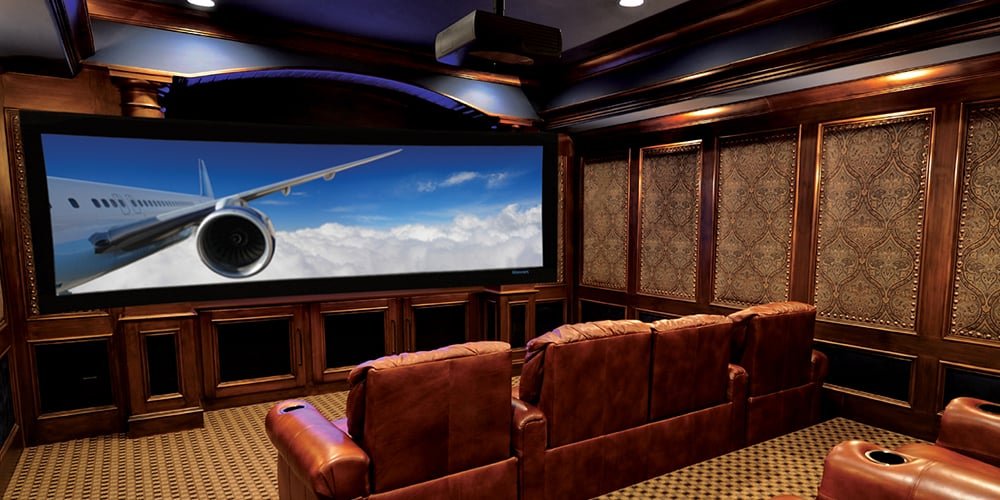

Creating a dedicated home cinema is every movie lover’s dream — but most homeowners misunderstand one of the most critical parts of the entire project: sound.
People usually invest in big screens, Dolby Atmos soundbars, or powerful surround speakers but often ignore the two elements that decide whether the audio will be crystal clear or completely ruined:
- Soundproofing
- Acoustic Treatment
Although these terms are often used interchangeably, they are not the same.
They serve different purposes, use different techniques, and require different planning.
This in-depth guide clearly explains what each one does, how they work, which one your home cinema truly needs, and how to design both for maximum performance.
1. What Is Soundproofing?
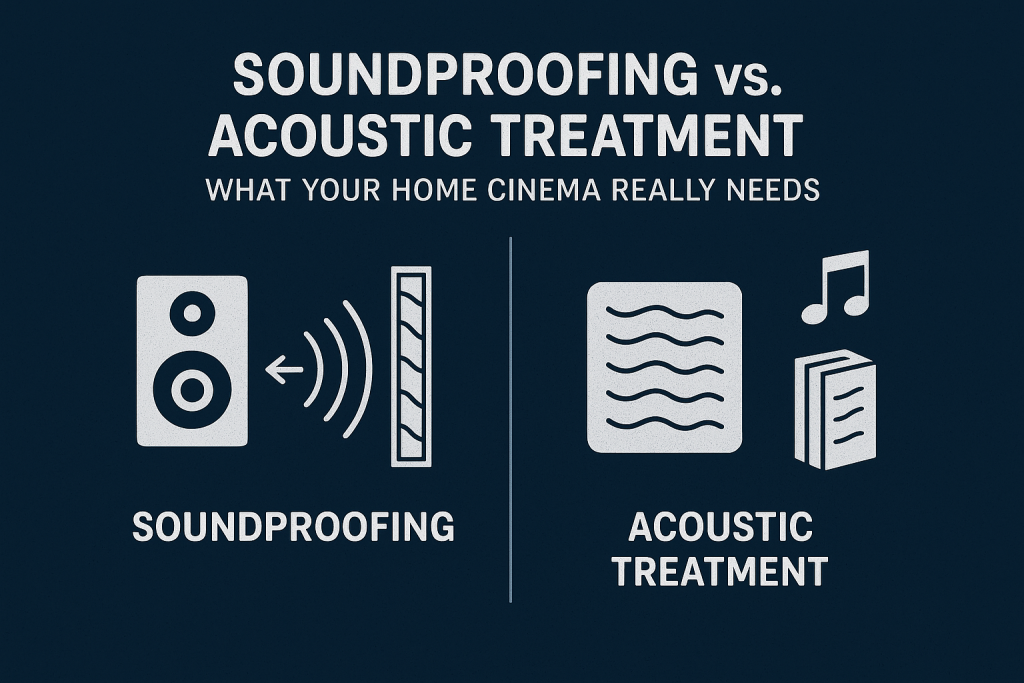
Soundproofing is the process of blocking sound from entering or leaving your home cinema room.
Its purpose is to:
- Keep movie noise inside the room
- Prevent outside noise from disturbing your movie
- Maintain privacy
- Stop low-frequency bass from leaking to other rooms
Soundproofing is all about isolation.
You are trying to create a sealed “audio box” where sound cannot escape and external noise cannot enter.
1.1 How Soundproofing Works (The Science)
Sound travels through air particles and solid structures. To stop this, soundproofing uses four principles:
1. Mass – heavier walls stop more sound
Materials like cement board, gypsum, acoustic drywall, and dense insulation add weight.
2. Decoupling – separating surfaces
Floating walls, resilient channels, and double-stud walls prevent vibrations from transferring.
3. Absorption inside walls
Rockwool or dense mineral wool absorbs sound inside cavities.
4. Airtight sealing
Even a tiny 1% gap can leak 50% of the sound.
Therefore, soundproofing requires sealing:
- Doors
- Windows
- Wall joints
- Switchboards
- Outlets
Without sealing, soundproofing fails.
1.2 Soundproofing Materials (What Works and What Doesn’t)
Effective Materials
- Double-layer acoustic drywall
- Resilient channels
- Rockwool / Mineral wool insulation
- Mass Loaded Vinyl (MLV)
- Solid core acoustic doors
- Acoustic weatherstrips
- Double-glazed acoustic windows
Not Effective (Common Misconceptions)
- Foam panels (they do NOT soundproof)
- Egg trays
- Thin carpets
- Curtain soundproofing claims (90% are marketing gimmicks)
These items may change some frequencies inside the room, but they cannot stop sound from leaving the room.
2. What Is Acoustic Treatment?
Acoustic treatment focuses on improving the sound inside the room, not blocking it.
Its purpose is to ensure:
- Clear dialogues
- Balanced bass
- Accurate sound stage
- No echoes or reverberation
- No harsh reflections
While soundproofing is about keeping noise in/out, acoustic treatment is about making the audio sound perfect within the room.
2.1 How Acoustic Treatment Works
It uses three main tools:
1. Absorption
Reduces echo and reverb
Materials used:
- Acoustic panels
- Fabric-wrapped panels
- Rockwool panels
- Acoustic ceiling clouds
2. Diffusion
Breaks up sound reflections
Used to create a natural spacious sound.
Materials:
- Diffuser panels
- Skyline diffusers
- QRD diffusers
3. Bass Traps
Manage low-frequency build-up (most important element)
Bass tends to accumulate in corners — bass traps absorb and balance it.
Materials:
- Superchunk corner traps
- Large rockwool traps
- Membrane bass traps
4. Does Your Home Cinema Need Soundproofing?
It depends on your situation. Ask yourself:
4.1 Do you want to prevent disturbing others?
Home theaters with powerful subwoofers (especially Dolby Atmos setups) cause vibrations.
If you live:
In an apartment
Near bedrooms
Close to neighbors
In a shared house
You must soundproof to avoid complaints.
4.2 Do you want to avoid outside noise?
If your room is near:
Traffic
Kids’ play area
Main road
Kitchen or hall
Then soundproofing becomes important.
4.3 When Soundproofing Is Not Necessary
If the room is on a separate floor
If the cinema is built in a basement
If the room is far from sleeping areas
If walls are already thick and solid
5. Does Your Home Cinema Need Acoustic Treatment?
YES — always.
Whether your cinema is in the living room, bedroom, or a dedicated theater, acoustic treatment is a must.
Without treatment:
Dialogue will sound muddy
Bass will be uneven
Echo will reduce clarity
High frequencies will be harsh
The entire experience will feel low-quality
Even a ₹1 lakh acoustic treatment can improve audio more than upgrading from a ₹2 lakh system to a ₹5 lakh system.
6. Real-World Examples
Case 1 — No Soundproofing + No Acoustic Treatment
Loud sound leakage
Disturbs family
Echo ruins clarity
Bass booms in some seats and disappears in others
Case 2 — Soundproofing only
Outside noise is blocked
But inside sound is still unclear
Echo and reflections remain
Case 3 — Acoustic Treatment only (Most Common Setup)
Clean, clear, balanced sound
Some noise might leak
Perfect for rooms where leakage is not a big concern
Case 4 — Soundproofing + Acoustic Treatment (Ideal)
Theatre-level audio
No leakage
Perfect bass
Balanced reflections
7. Designing a Perfectly Treated Home Cinema (Full Guide)
7.1 Step 1: Room Size & Shape
Best room ratios avoid echo and standing waves.
Ideal ratios:
1 : 1.4 : 1.9
1 : 1.6 : 2.3
1 : 1.3 : 1.9
Avoid square rooms.
7.2 Step 2: Speaker & Seat Placement
Acoustics are 40% speaker placement.
Keep front LCR speakers at ear level
Subwoofer positioning affects 50% of bass performance
Avoid placing seats touching walls
7.3 Step 3: Absorbers Placement
Place absorbers at:
First reflection points
Ceiling above seats
Back wall
Side walls
Use 2–4 inch thick panels for best performance.
7.4 Step 4: Bass Traps
Use superchunk traps in all four corners.
Low frequencies are the hardest to control — bass traps fix that.
7.5 Step 5: Diffusers
Install diffusers on back walls to create a spacious, cinema-like ambience.
7.6 Step 6: Soundproofing (If Needed)
Best combination:
Double drywall
MLV
Rockwool insulation
Acoustic door
Window sealing
8. Cost Breakdown
Soundproofing Cost (India)
Basic: ₹1.5 – ₹3 lakhs
High-end: ₹4 – ₹10 lakhs
Acoustic Treatment Cost (India)
Basic: ₹60,000 – ₹1.5 lakh
Mid-range: ₹1.5 – ₹3 lakh
High-end: ₹3 – ₹7 lakh
9. Homeowner Mistakes to Avoid
❌ Mistake 1: Using acoustic foam to soundproof
Foam does NOT block sound.
❌ Mistake 2: Ignoring bass traps
Bass is the heart of cinema sound.
❌ Mistake 3: Treating only one wall
Acoustics requires balanced treatment.
❌ Mistake 4: Overusing absorption
Too much absorption = dead, flat sound.
10. Final Recommendation: What Your Home Cinema Really Needs
If your goal is cinematic sound inside the room:
👉 Acoustic Treatment is 100% required
If your goal is to stop disturbing others:
👉 Soundproofing must be added during construction
If you want both perfect isolation + perfect sound:
👉 Use both soundproofing + acoustic treatment
Most modern homeowners choose:
Acoustic Treatment first
Add soundproofing if noise leakage becomes an issue
Learn more about our complete home automation solutions
11. Conclusion
A well-designed home cinema is not only about screens, speakers, and projectors.
The real magic comes from controlling sound — both inside and outside the room.
Soundproofing controls noise leakage
Acoustic treatment controls sound quality
If you want true theatre-like experience, clear dialogues, powerful bass, and zero echo — acoustic treatment is the foundation.
If you want privacy and zero disturbance — soundproofing completes the system.
Together, they give you the immersive, high-performance cinema you always dreamed of.